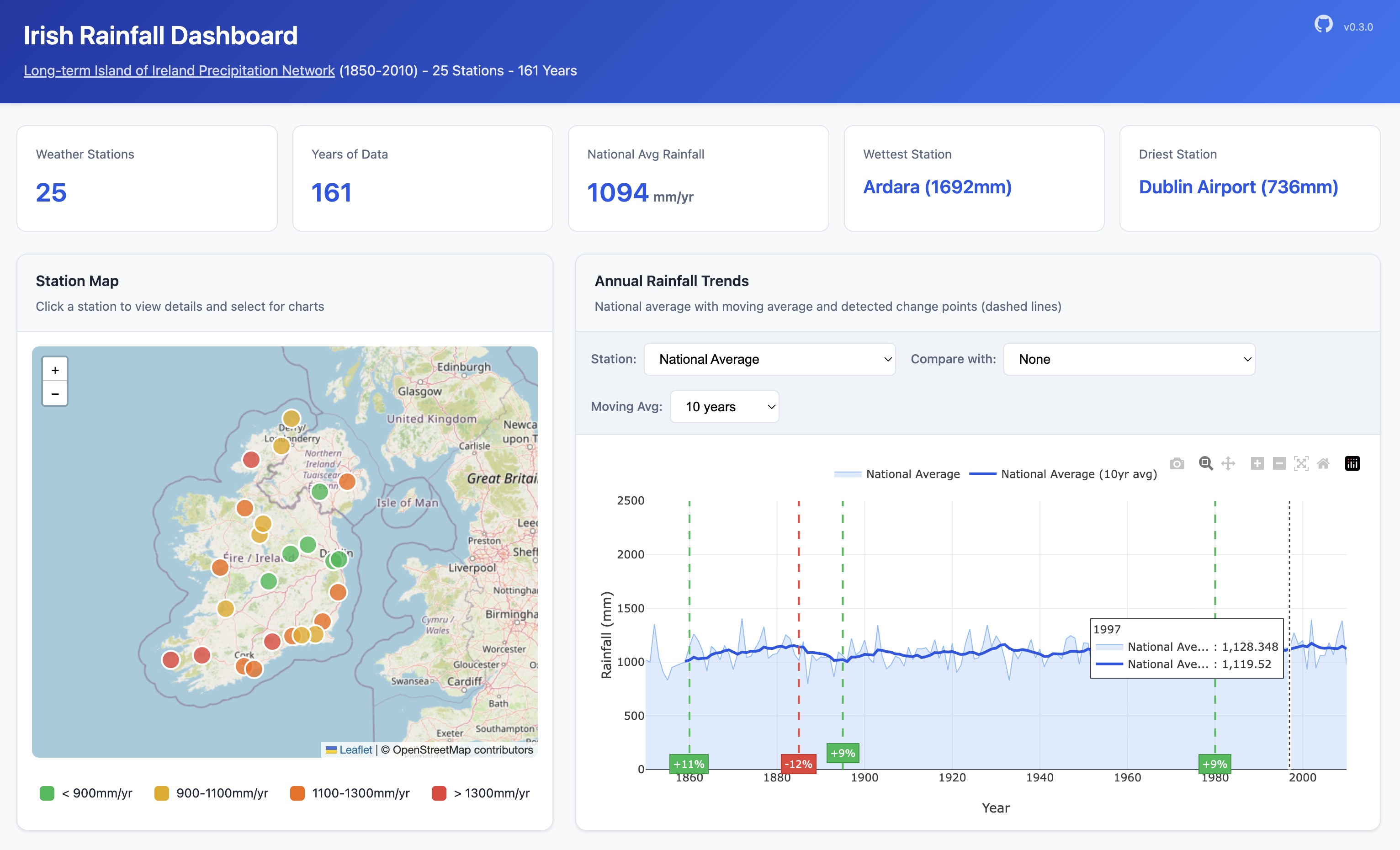
The dashboard at a glance: stations colour-coded by long-term average on the
left, the national series with its 10-year moving average and detected
change points on the right.
In Ireland, two things are true: people will talk about
the weather, and the weather will give them plenty to talk about. But how
much of what we feel about Irish rainfall — that it's wetter than it used
to be, that the seasons have shifted, that some corner of Cork must surely
hold a world record — actually shows up in the data?
The Irish Rainfall Dashboard is a small project I built to make that
question easy to poke at. It takes the Long-term Island of Ireland
Precipitation (IIP) network — 25 weather stations, monthly readings, 1850
to 2010 — and puts it behind an interactive map and a handful of charts so
you can explore 161 years of Irish weather without writing a line of code.
Where the data comes from
The underlying dataset is published by Met Éireann and
was reconstructed and quality-controlled by Mateus, Potito and Curley (2020).
It contains monthly rainfall totals for 25 stations spread across the island,
along with a national series. The dashboard pulls the raw archive directly
from Met Éireann's site, unpacks it, and loads it into a small SQLite
database — so the whole thing is self-contained and reproducible from a
single command.
A few headline numbers to set the scale:
|
|
| Stations |
25 |
| Years of data |
161 (1850–2010) |
| National average |
1094 mm/yr |
| Wettest station |
Ardara — 1692 mm/yr |
| Driest station |
Dublin Airport — 736 mm/yr |
The east–west contrast is the first thing that jumps out: the wettest
station in the network records more than twice the annual rainfall of
the driest, and the driest sits right next to the country's biggest city.
What you can do with it
The dashboard is designed for browsing rather than dashboards-by-committee.
Everything is one click away.
- Interactive map — All 25 stations plotted on a Leaflet map, colour-coded
by long-term average rainfall. Click any station to drill into its data, or
pick from a dropdown to highlight it.
- Annual rainfall trends — A time-series chart for any station (or the
national average) with configurable 5/10/20/30-year moving averages, so
you can damp out the year-to-year noise and see the underlying signal.
You can also overlay a second station to compare.
- Change point detection — The dashboard runs the
ruptures PELT algorithm
over each series and marks the years where the rainfall regime appears to
shift. It's a nice antidote to eyeballing trends.
- Monthly climatology heatmap — Average rainfall by station and month,
laid out as a heatmap. The seasonal pattern across the island is
immediately visible.
- Period comparison — Pick any two date ranges and the dashboard reports
the percentage change between them, station by station.
- Seasonal breakdown — Winter / Spring / Summer / Autumn averages per
station, so you can ask questions like "is it really the winters that
are getting wetter?"
There's also a small REST API behind it (/api/stations,
/api/rainfall/annual, /api/rainfall/changepoints, …) for anyone who'd
rather pull the numbers into a notebook.
How it's built
I wanted the project to be light enough to run on a laptop and simple
enough to read end-to-end in an afternoon. The stack reflects that:
- Python 3.12 with
uv for environment
and package management
- FastAPI for the API and server-rendered templates
- SQLite as the data store — a single file, no daemon, perfect for a
read-mostly dataset of this size
- Leaflet for the map and Chart.js for the time-series charts
ruptures for change point detectioninvoke tasks for everything admin (invoke import-data,
invoke start, invoke stop, invoke status, invoke db-info)
Getting it running locally is two commands:
uv sync
invoke import-data   # downloads from Met Éireann and builds the SQLite db
invoke start         # serves the dashboard at http://127.0.0.1:8000
Why bother?
Honestly, mostly because the dataset is wonderful and deserves more eyeballs
than a folder of CSVs ever gets. Long, clean, public time series are rarer
than they should be, and 160 years of Irish rain is the kind of thing that
rewards a little curiosity. Try poking at Valentia Observatory's winters,
or Markree's change points, or what Dublin Airport looked like in the
1970s — there's a story in nearly every series.
If you find something interesting, an issue or a PR on the
GitHub repo is very
welcome.
Links
The project is MIT-licensed.